ObserveOne and Mabl both touch browsers and APIs, but they are built for different jobs. Mabl is a QA platform for pre-production test automation. ObserveOne is a production monitoring platform that also generates and runs Playwright tests with Autopilot. This post covers where each one wins and how to choose.
At a Glance: Monitoring vs Testing#
| Feature | ObserveOne | Mabl |
|---|---|---|
| Primary Use Case | Production monitoring + incident management | Pre-production testing + QA workflows |
| Test Authoring | Autopilot (paste a URL, AI generates Playwright) | Agentic AI + Low-Code (Trainer or AI builder) |
| Self-Healing | LLM healer agent re-fixes broken tests | Heuristic (attribute matching + fallbacks) |
| API Monitoring | Multi-region checks + JSONPath + heartbeats | API tests + Postman import + AI assertions |
| Uptime Monitoring | URL Monitors + multi-region | Via scheduled test runs (workaround) |
| Incident Management | Built-in (priority, assignee, timeline) | Not applicable |
| Alert Channels | 7 types (Email, Slack, Discord, Teams, Telegram, SMS, Webhook) | Email, Slack, Teams, webhooks |
| Status Pages | Public status pages for customers | Not applicable |
| CI Integration | GitHub App + GitLab (checks, PR/MR comments) | GitHub, Jenkins, CircleCI, Azure DevOps |
| Onboarding | Zero-install (web-only) | Desktop app (Chrome required) |
| Ideal For | DevOps, SRE, developers | QA engineers, test teams |
Pricing Snapshot#
ObserveOne pricing as of March 2026. Mabl is quote-based (no public self-serve price).
| Plan | $/mo (monthly) | $/mo (annual) | AI verification runs | Monitors | Check interval | Users |
|---|---|---|---|---|---|---|
| Free | $0 | $0 | 10 | 10 | every 2h | 1 |
| Starter | $7 | $6 | 25 | 25 | every 5m | 1 |
| Essential | $29 | $24 | 80 | 50 | every 60s | 1 |
| Small Team | $99 | $85 | 200 | 500 | every 30s | 10 |
Mabl has no free tier (14-day trial only) and no public self-serve pricing; every plan is a sales quote.
1. Different Tools for Different Jobs#
Comparing ObserveOne and Mabl is like comparing New Relic to Postman. Both touch APIs and browsers, but they solve different problems.
Mabl is for QA engineers: record flows in a desktop Trainer, organize tests into Plans, run mobile and load tests, and plug into Jira, Jenkins, and CircleCI. A mature platform for teams that live inside their testing tools.
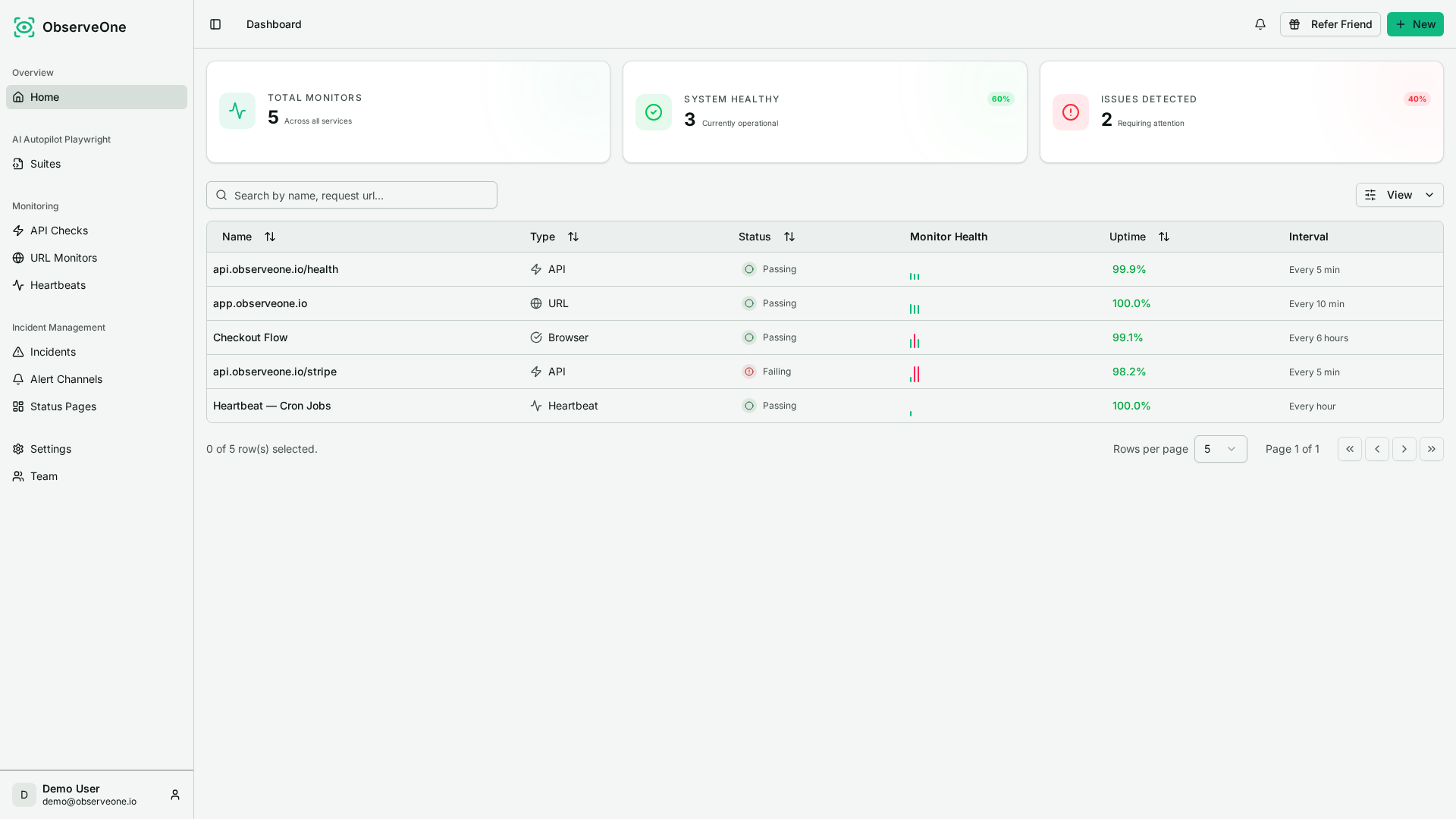
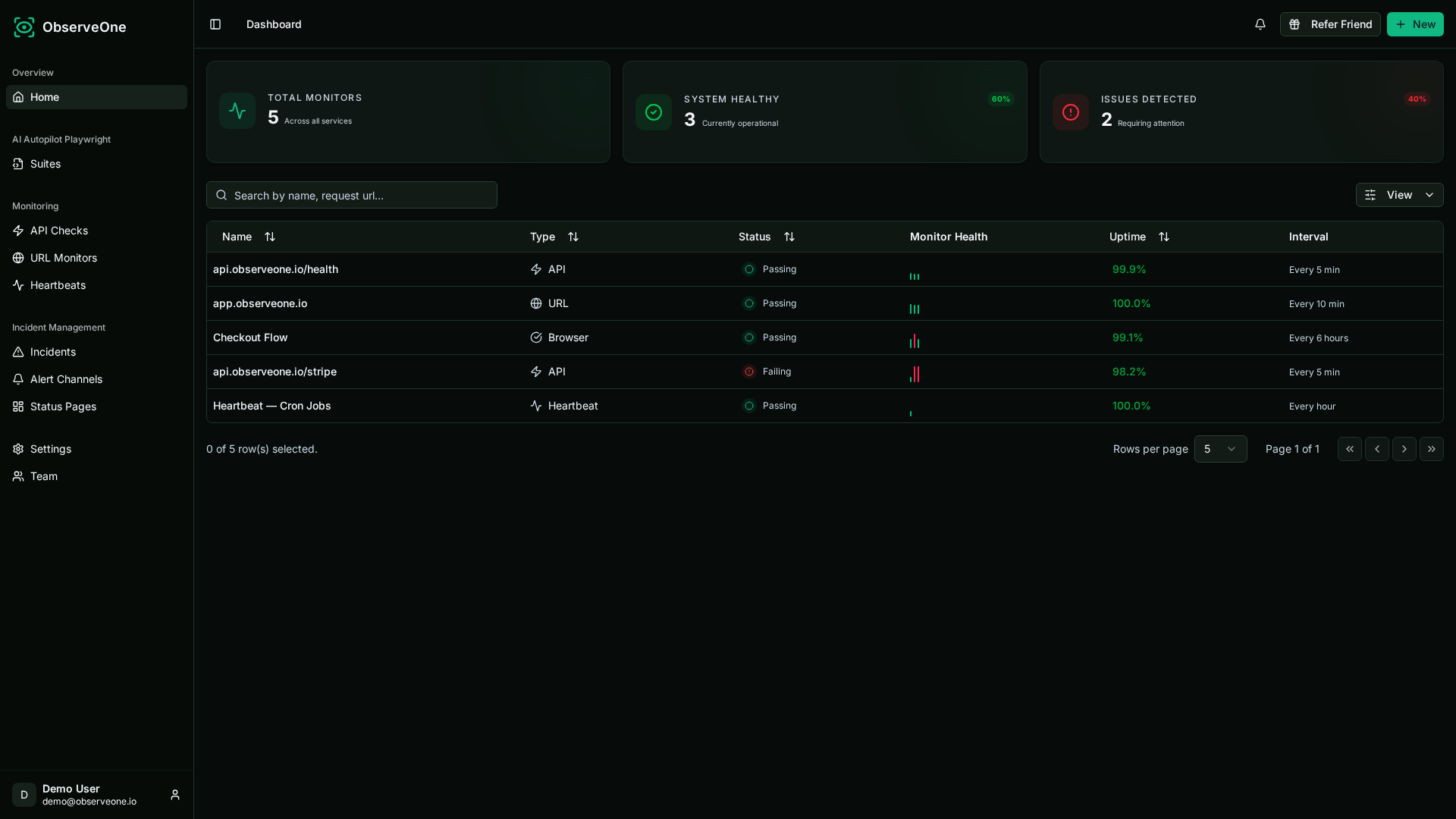
ObserveOne is for developers and DevOps: monitor production uptime across regions, track incidents, alert through seven channels, share public status pages, watch cron jobs with heartbeats, and generate Playwright suites with Autopilot.
2. Where Mabl Excels#
If you are building comprehensive pre-production test suites, Mabl has depth ObserveOne does not:
- Mobile testing on cloud iOS/Android devices
- Performance / load testing by reusing browser or API tests
- Visual regression: crawls pages, detects diffs, broken links, JS errors
- Test organization: Flows, Snippets, Datatables, branch-aware tests, change history
- Accessibility testing and data-driven testing
- Cross-browser execution on Chrome, Edge, Firefox, Safari
The trade-off is setup weight: authoring runs through the Trainer desktop app with local Chrome, which feels heavy next to a paste-a-URL workflow, especially for developers on Linux.
3. The ObserveOne Difference: Monitoring-First#
Zero-Friction Start#
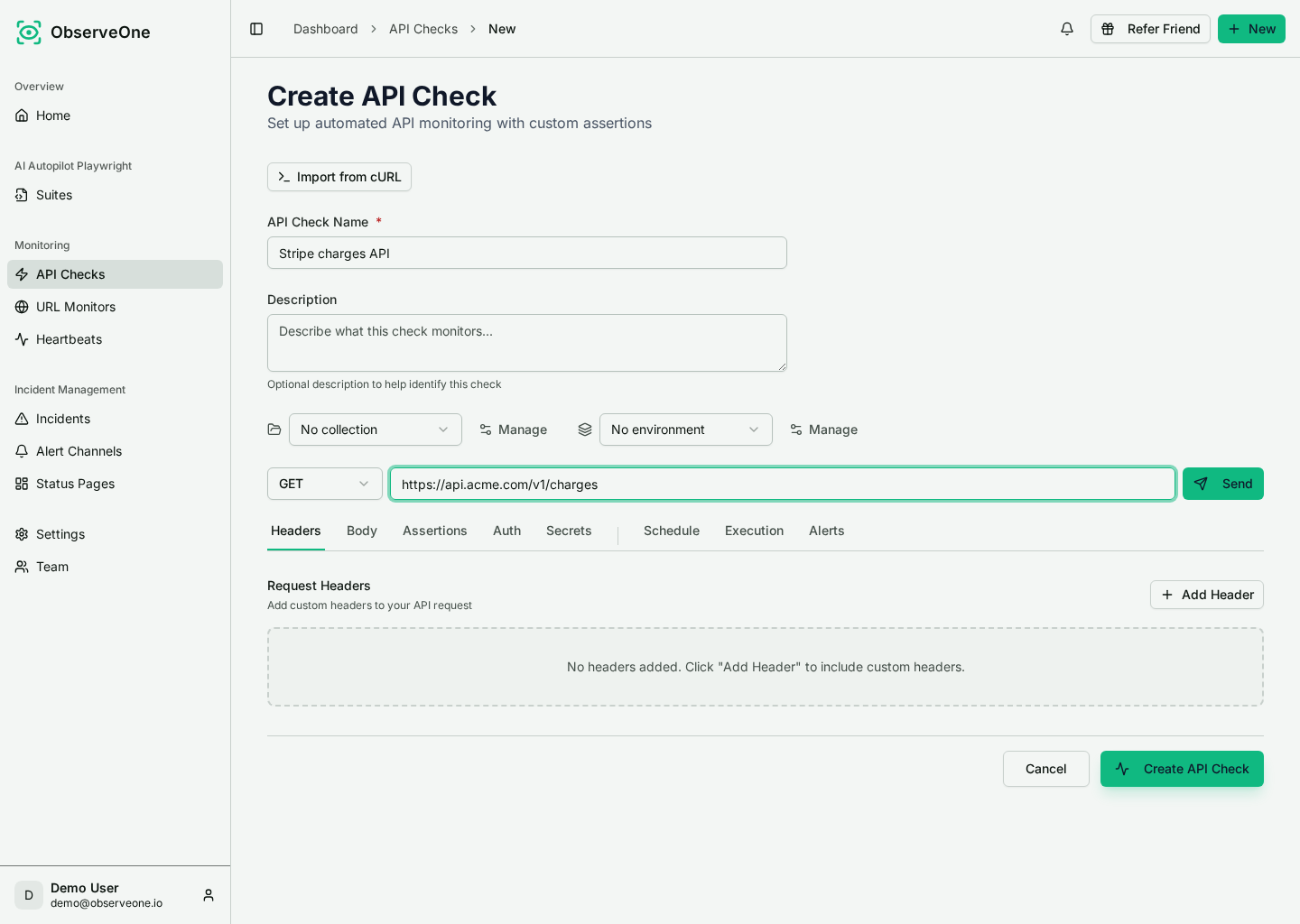
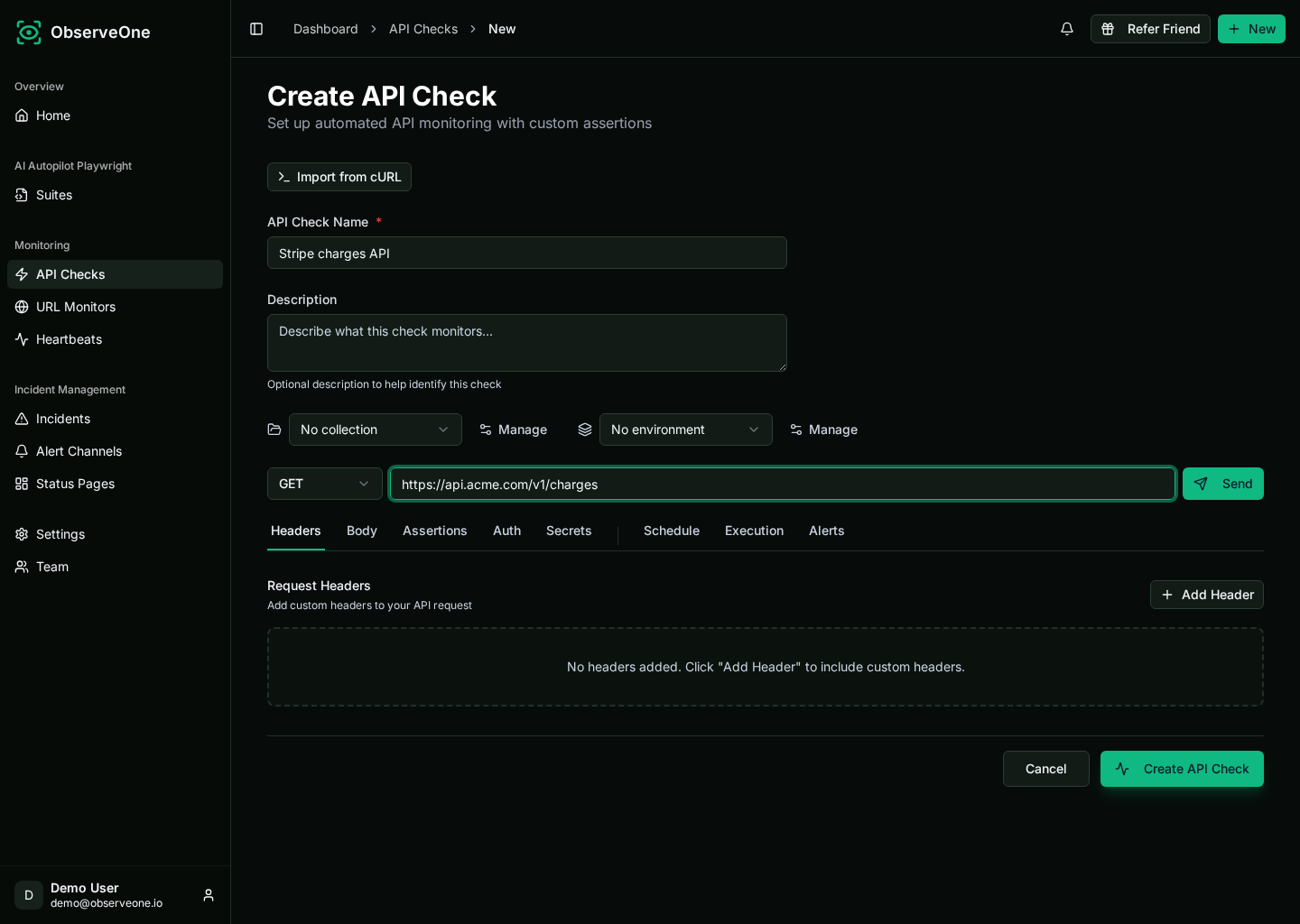
To monitor a new checkout API: log in from any browser, click "New API Check," paste the endpoint, add JSONPath assertions, pick regions, and set the schedule. Live in under two minutes, no desktop app required.
Autopilot: AI-Generated Playwright Tests#
Where Mabl has you record each test, ObserveOne's Autopilot takes a URL, plans the flows itself, and generates a Playwright suite. When a test breaks, a healer agent re-fixes it instead of sending you back to a recorder. Suites gate CI through the GitHub App or GitLab with status checks and PR comments, and the output is real Playwright you can edit and keep.
API Checks#
Multi-region API monitoring with deep validation: status codes, JSONPath (e.g. $.data.user.permissions[0].role exists), response-time thresholds, and header checks. Run the same check from US, EU, and Asia at once, built for continuous production monitoring.
URL Monitors and Status Pages#
URL Monitors are lightweight uptime checks across regions, no browser overhead, just "is this URL returning 200?" Status Pages share public uptime with customers during incidents without exposing internal details. Mabl has neither.
Heartbeats#
Give a cron job a unique ping URL. If it does not call in on schedule, ObserveOne opens an incident and alerts your team, covering backups, ETL, and cleanup jobs. Mabl has no equivalent.
Incidents and Alerts#
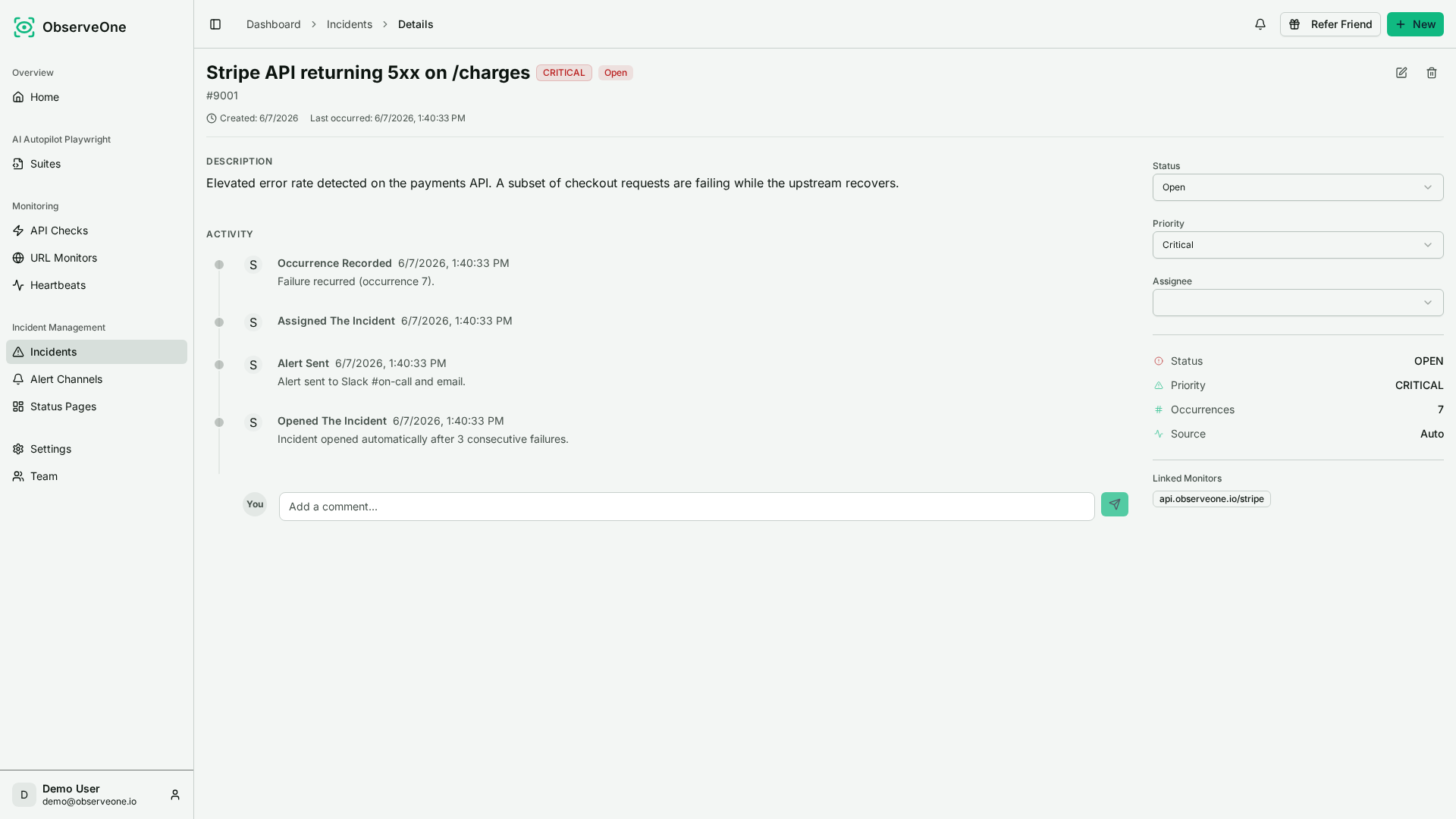
When checks fail, ObserveOne auto-creates incidents with priority, assignment, a timeline, and resolution tracking, then routes alerts across seven channels (Email, Slack, Discord, Teams, Telegram, SMS, Webhook) for on-call rotations.
4. Which Tool for Your Team?#
Choose Mabl when you have a dedicated QA team, your focus is pre-production testing, you need mobile or load testing, or you want test branching and rich history across many testing modalities.
Choose ObserveOne when you are a developer-led team, your priority is production monitoring with incidents, alerts, and status pages, and you want AI-generated Playwright suites that self-heal and gate CI without a recorder. How that healer behaves, including what happens when a heal is wrong, is written up in our self-healing test automation guide.
The core distinction: Mabl is a QA platform that can monitor production. ObserveOne is a monitoring platform that also generates and runs E2E tests. Pick based on your primary need.
Conclusion#
It comes down to testing platform vs monitoring platform. For comprehensive test suites before deployment, Mabl gives you the structure. To know the second production breaks, with incidents, alerts, status pages, heartbeats, and self-healing Playwright suites, that is why we built ObserveOne.